

Jill Chism’s Call of the Running Tide

Words by Maura Mancini

I could have spent hours chatting with Jill Chism in her Oak Beach studio. 

Set among tropical vegetation, her workspace feels like an extension of the surrounding environment. Natural light pours through skylights, creating the sensation of being outdoors beneath the rainforest canopy. Birdsong drifts through the trees outside. The space is eclectic, and every corner tells a story: pieces of driftwood, found objects, natural materials, well-used tools and fragments collected over years of walking through the landscape, observing the natural world and listening to its stories.

Nothing here is simply what it appears to be. In Jill’s hands, forgotten objects are given new life. A piece of driftwood washed ashore after a cyclone is no longer just timber. Shaped by wind, saltwater and time, it might reveal an almost human form, an animal presence or a story hidden within its grain. What others may overlook as debris Jill recognises as a fragment of a larger story. She does not impose meaning on these materials, but listens for the stories they already carry.

This ability to see beyond the obvious has shaped Jill Chism’s environmental art practice for more than 30 years. Working across multimedia, sculpture and installation, she has developed a distinctive visual language built around transformation, connection and respect for natural and found materials.

Since making her home in Oak Beach in 2003, Jill has been immersed in one of the world’s most remarkable environments: where the world’s oldest tropical rainforest meets the Great Barrier Reef. Surrounded by incredible biodiversity, she began exploring the connections between ecology, place and environmental history.

Reading Daintree Blockade by Bill Wilkie deepened that curiosity, revealing the environmental activism that shaped the Douglas Shire and helped protect one of Australia’s most unique landscapes.

How can art help us see the natural world differently?

That question became Call of the Running Tide, one of Far North Queensland’s most ambitious environmental art projects. More than an exhibition, it has evolved into an ongoing conversation between artists, scientists, traditional owners, environmental organisations and local communities about the fragile coastal ecosystems we all share.

Originally conceived in 2011 and formally presented to the Port Douglas Arts Association in 2017, Jill’s vision was never simply to curate an exhibition. She imagined a collaborative platform where artists could engage deeply with environmental science, create work inspired by specific places, and encourage audiences to reconsider both their relationship with nature and their understanding of environmental issues.

Rosey and Ross Cummings, together with Tim Ellis, recognised the potential of the idea and helped bring it to life. Together they developed partnerships, secured funding and began transforming an ambitious vision into a community-wide environmental arts festival.

As Jill explains: “Environmental art is created to inspire care and respect, stimulate dialogue, and encourage the long-term flourishing of the social and natural environments in which we live.”

The inaugural Call of the Running Tide Environmental Art Festival transformed Port Douglas and Mossman into an open-air gallery in September 2019. Rather than occupying white gallery walls, many works were installed directly in beaches, parks and community spaces, allowing the landscape itself to become part of the exhibition.

I still remember wandering through Rex Smeal Park and Little Cove during that inaugural festival. Some artworks appeared to merge seamlessly with the landscape, while others deliberately disrupted it, confronting visitors with the impact of human activity on the natural world. Together, they transformed familiar places into spaces for reflection, curiosity and conversation.
People stopped to look closely. Children asked questions, while strangers found themselves sharing observations and ideas. The works invited us to look more closely at places we often take for granted and, in doing so, encouraged a deeper awareness of the environmental issues affecting them.

Workshops and later exhibitions strengthened collaborations with organisations including Tangaroa Blue’s Marine Debris Initiative, Great Barrier Reef Legacy, Mangrove Watch, the Douglas Shire Sustainability Group, as well as researchers and environmental practitioners sharing knowledge about coastal ecosystems and the challenges facing them. A satellite exhibition followed at NorthSite Contemporary Arts in Cairns before a larger second festival returned to Port Douglas in 2021.

Across all these events, a documented audience of more than 15,000 people attended, with overwhelmingly positive feedback recognising both the festival’s environmental focus and the outstanding quality of the artworks. Call of the Running Tide blurred the boundaries between disciplines: scientists contributed observations, environmental organisations shared decades of collected data, and Traditional Owners brought cultural knowledge of Country. Artists transformed this knowledge into emotional experiences capable of reaching audiences in a powerful way. The festival demonstrated that art could communicate environmental issues in ways that facts and statistics alone often cannot.

The project has continued to evolve with its latest chapter, Call of the Running Tide - The Littoral Zone, focusing on the intertidal zone, the constantly changing space between high and low tide.

This fragile coastal environment supports extraordinary biodiversity while revealing many of the pressures facing Queensland’s coastline. Following its presentation at the Tanks Arts Centre in Cairns in July and August, the exhibition continues at the Sugar Wharf in Port Douglas from 14 to 21 November 2026.

Under Jill Chism’s curatorial direction, artists from the Douglas Shire and Cairns regions have spent months researching specific coastal sites stretching from Cow Bay in the Daintree to Trinity Inlet and the Cairns Esplanade. Working alongside environmental organisations and researchers, they have developed new works through site observation, scientific knowledge and creative experimentation before transforming them into multimedia installations, sculpture and photography.

Visiting the exhibition at the Tanks Arts Centre in Cairns, I was struck by both the beauty of the works and the uncomfortable truths they revealed. This is what makes The Littoral Zone so powerful. It does not simply ask us to admire the natural world; it invites us to recognise the challenges facing it.

Walking through the exhibition, I found myself moving between moments of wonder and moments of reflection. The works reveal stories of regeneration, biodiversity and connection, while also confronting issues many of us know exist but may not fully acknowledge marine debris, pollution, waste and the impact of human activity on coastal environment.

Some works reveal ecosystems and regeneration, while others examine waste, pollution and toxicity through a localised, site-specific response to the coastal environments they explore. Every beach tells a different story. Some reveal resilience and renewal; others expose the consequences of consumption, waste and a changing climate. Together, the works create a portrait of a coastline that is both beautiful and vulnerable. Environmental art may not offer solutions, but it asks us to look more carefully, question our relationship with the natural world and consider our role in protecting it.

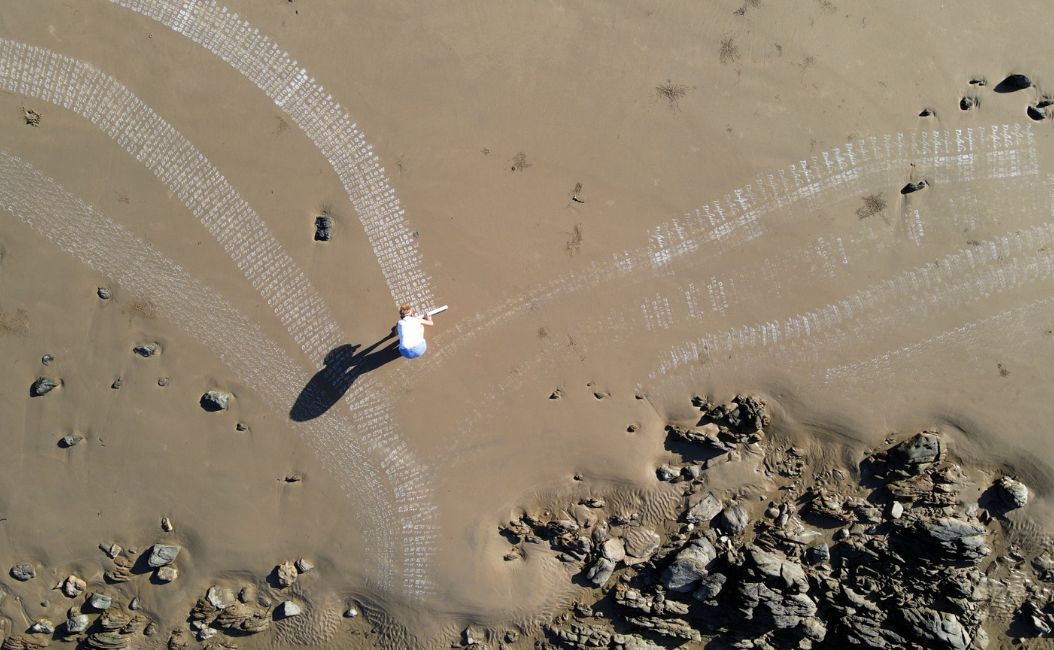
Jill’s own work, Conserve, Preserve: We are the Salt of the Earth, continues her exploration of the relationship between humans and the ocean.

Extending a series of salt prints created in tidal zones since 2008, the installation responds to the decline and disappearance of marine biodiversity. First created on Cape Kimberley Beach in response to Tangaroa Blue’s Marine Debris Initiative - which recorded the removal of 32 tonnes of waste from the area between 2010 and 2025 - the work reflects on our relationship with waste and the responsibility we share in protecting coastal ecosystems. Like a mandala, each temporary print is eventually erased by the incoming tide, leaving no trace on the natural environment.

Another of her works, All That Is Gone Is Not Lost, explores the consequences of excessive consumption, landfill expansion and ocean pollution by drawing attention to the relationship between what we discard and what remains in the natural environment. Rather than offering simple answers, the work invites reflection on transformation, responsibility and the fragile relationship between humans and nature.

Behind this ambitious project is Jill herself: artist, curator, organiser, mentor and advocate.

Bringing together a major environmental art project requires enormous commitment: developing partnerships, securing funding, supporting artists, building relationships with researchers and environmental organisations, and ensuring the message remains meaningful and connected to place. Jill has played a central role in guiding this vision, often carrying many responsibilities behind the scenes while bringing together a diverse network of collaborators.

Yet perhaps one of her greatest achievements is not only the exhibitions themselves, but the community she has helped create, a network of artists, scientists, Traditional Owners, environmental organisations and supporters who have contributed their knowledge, creativity and passion to the ongoing conversation.

For the work to continue, younger artists are encouraged to participate, develop their own voices and become the next generation of creative custodians of the landscape. Through Call of the Running Tide, emerging artists discover how art can become an active force in environmental conversations. After years of creating, connecting and organising, Jill understands that the future of the project depends on fresh perspectives and new voices.

Every landscape holds stories. Every material carries memory. And if we learn to look closely enough, the natural world is always speaking.

Standing in Chism's Oak Beach studio, surrounded by sketches, found objects and works in progress, it becomes clear that Call of the Running Tide is ultimately about attention. Attention to tides. To birds. To plastics carried by currents. To histories embedded within landscapes. To the fragile spaces where rainforest, reef and human activity collide.

In a region celebrated worldwide for its natural beauty, Chism reminds us that admiration alone is no longer enough. The coast is speaking. Through art, science and community, Call of the Running Tide invites us to finally listen.