

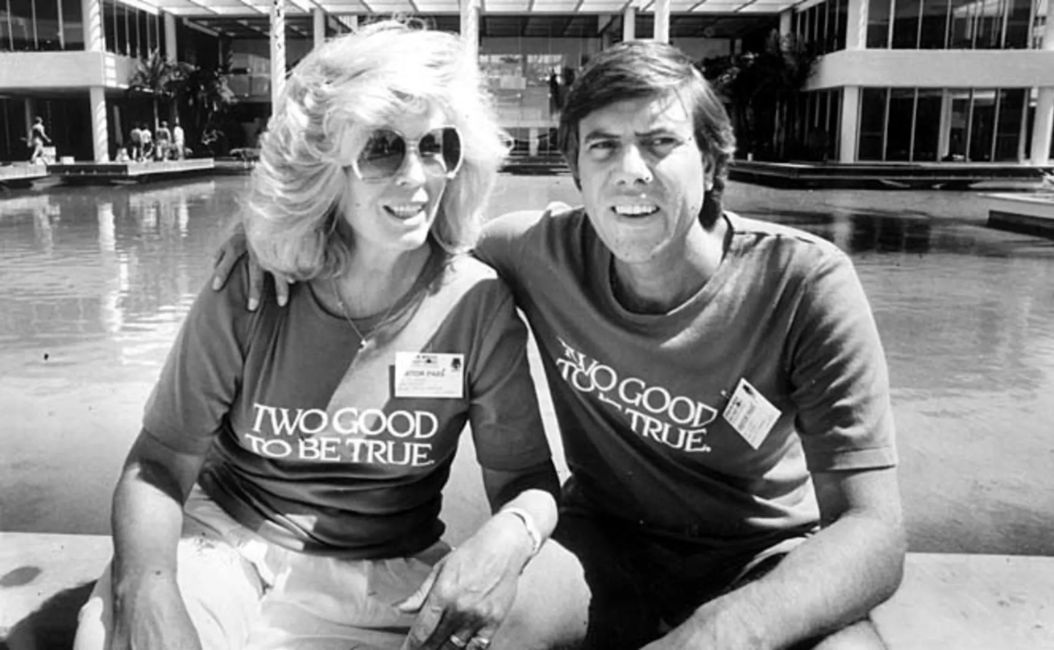
Words by Sara Mulcahy

There are many things’ visitors love about Port Douglas, from its idyllic beach and proximity to the rainforest and the reef, to its colourful shops and award-winning cafes and restaurants. But the first — and last — impression of the town is often forged by the iconic avenue of palm trees that line the main road as you veer off the Captain Cook Highway on your way into town. And we have one man to thank for that: Christopher Charles Skase. 

As part of his ultra-luxe Sheraton Mirage hotel development in the 1980s, Skase wanted a grand, tropical entrance to Port Douglas. To achieve that goal, he spent millions of dollars buying a palm tree plantation up in the Daintree Rainforest and bringing in 1400 mature African oil palms (Elaeis guineensis) by ferry, road and helicopter. A 2021 Douglas Shire council audit found 608 of the original trees remaining, which are now maintained and protected as a key part of the area's tourist appeal.

Skase may have been a liar, a cheat and a crook, but there’s no denying the man had vision.

The beginning

Skase first visited Port Douglas as a 21-year-old traveller in 1969. At that time, the town was all but abandoned. The gold rush was long over, a new railway had bypassed the once bustling port, and the population had sunk to just a few hundred people seeking a life away from the rat race.

But the image of a wild and beautiful Four Mile Beach sparked an idea in the would-be entrepreneur’s mind, one that would take another two decades to bring to fruition. 

By the early 1980s, Skase had relocated from his hometown of Melbourne to the Queensland capital, Brisbane, and was an intermittent visitor to Port Douglas, popping by on his yacht on fishing trips out of Cairns.

He was now a fantastically successful businessman, running his financial services and investment company, Qintex, and married to his glamorous socialite wife, Pixie. His idea to build a luxury resort on Four Mile Beach was finally within his grasp, but for a few pesky problems.

First, he needed to raise even more money to finance his ambitious project, which Sheraton was contracted to manage. Luckily, he wasn’t one to lose sleep over embellishing the truth.

The investment manager tasked with that job reportedly confessed to sending a photographer to Hawaii, and passing off the pictures as Four Mile Beach, to persuade investors to part with their cash. 

Second, the tranche of land Skase wanted to build on was owned by the state government. But he knew how to grease palms, and the National Party Premier at the time, one Sir Joh Bjelke-Petersen, wasn’t known for his adherence to the rulebook. (He’s reported as saying, “I don't care what you blokes do, as long as you bring your money to Queensland.”)

While the development was cautiously welcomed as a windfall for local businesses, there was also opposition — as there still is to large-scale development today — over the risks to the mangroves, the rare native flora and fauna, and the general laidback vibe of the town.

Skase ignored these concerns, as he did the fact that Jabukanji (Port Douglas) was a significant ceremonial site for Cape York First Nations people. Bama elders were at no time consulted on the design or construction of the resort. (Because of this, the elders were unsurprised by his — spoiler alert — untimely demise.)


Parties and palm trees

Having jumped and kicked over any remaining hurdles, Skase’s developers set to work. 

The Mirage Resort began to take its spectacular shape, with its signature pink façade and interiors overseen by Pixie.

Set on 147 hectares with direct access to Four Mile Beach, almost 300 rooms, suites and villas, complete with adjoining country club, were set among two hectares of swimmable (filtered) saltwater lagoons, landscaped tropical gardens, and an 18-hole golf course. And those famous palm trees greeted guests on arrival.

The Mirage Port Douglas opened its doors in late 1987, closely followed by the launch of the Marina Mirage on Wharf Street, where boutiques and booking offices were designed to service the cruising and sailing wants of Mirage guests. The resort was an instant success and is widely credited with transforming what was a sleepy town into a luxury playground for the rich and famous; a symbol of 1980s extravagance, putting Port Douglas on the map as a premier tourist destination. 

In September 1988, Mirage played host to Skase’s elaborate 40th birthday bash. Described as one of the biggest ‘who's who’ events in Australia to date, Skase flew in his favourite Hollywood A-listers, sporting heroes and a handful of journalists to record his success. John Farnham famously performed his latest hit, A Touch of Paradise, and Pixie sent the couple’s private jet to Melbourne to pick up a dress.

And then, all of a sudden, the party, for Skase at least, was over. In 1989, the National Companies and Securities Commission launched an inquiry into Qintex, discovering that the company was tens of millions of dollars in debt, and that Skase had been using company funds as his own personal bank account.

Skase, it seems, had seen the writing on the wall, funnelling enough money overseas to fund a decent, if not lavish, hasty retirement. His former bodyguard told the ABC that he had been sent in to clear out the penthouse at the Mirage, moving cars, furniture, jewellery and clothes into a container bound for Europe. The Skases spent one last Christmas under the Australian sun and followed suit.


The endgame

Christopher Skase sold 49% of the Mirage Port Douglas (and its Gold Coast counterpart) to Japanese investors in March 1989 for $433 million. His empire collapsed, and he fled abroad with personal debts of $170 million. Major creditors included those who had put up personal guarantees for bank loans, including Australian merchant bank Tricontinental Corporation (approximately $70 million); Japanese credit card company Nippon Shinpan ($37 million) and the State Bank of NSW ($11 million). He owed more than $1 million to the ATO and $32 million to his own collapsed company, Qintex.

The focus of the nation’s contempt, however, was fixed on the thousands of small shareholders, employees and creditors — the so-called ‘little people’ — who never saw a cent of their hard-earned money again.

And what became of Australia’s most wanted fugitive? A journalist working for the Sydney Morning Herald tracked him down to a wealthy enclave of Mallorca, about 50 miles off the east coast of Spain, in 1991. He was hiding out in a $3 million villa in the picturesque harbour town of Port Andratx, where he was often spotted dining out, swimming, socialising and playing tennis. In 1994, he avoided extradition back to Australia on the grounds of ill health, appearing in public using a wheelchair and wearing an oxygen mask. (When asked about his time in hospital detention, Skase reportedly quipped, "I mean, it was no Mirage resort.”)

To his creditors, his claimed lung disease was widely regarded as a fabrication. 

After multiple subsequent attempts at extradition by Canberra failed, he was finally granted ‘unconditional freedom’ by the Spanish courts, and told the attendant media that he was planning to write a tell-all memoir.

Skase died on August 5, 2001, at the age of 52, from stomach cancer. He was cremated in his adopted home, after which a half-decent life insurance policy allowed Pixie to quietly return to a small house in Melbourne’s Toorak, where she passed in 2024 at the age of 83.

Meanwhile, back in Port Douglas, Skase’s beloved Mirage has changed hands several times in the intervening years and has been owned by the Chinese multinational conglomerate and investment holding company Fullshare Group for the past decade.

Today, the resort hosts about 700 guests, rising to 900 at peak times. Famous travellers to have stayed there include former President of the United States Bill Clinton and his wife, former US Secretary of State Hillary Clinton; Hollywood stars Kate Hudson, Matthew McConaughey, Leonardo DiCaprio, Tom Hanks and John Travolta; opera singer Luciano Pavarotti; supermodel Claudia Schiffer; musicians Katy Perry with her then partner Orlando Bloom, and Mick Jagger and his ex-wife, model Jerry Hall; and reality TV star Kim Kardashian. 

Gone is the Pixie pink, courtesy of a multi-million refurbishment in 2016. On-site dining is headlined by the hatted restaurant Harrisons, operated by chef-owner Spencer Patrick, and the property remains Port Douglas's only five-star beachside resort.

Skase may be long gone, but his turquoise lagoons, his international standard golf course, and his majestic avenue of palms live on.