


Words by Maura Mancin
Often, the most memorable discoveries happen without planning. Earlier this year in Cairns, I stepped into an exhibition that lingered long after its closing date.
From Land to Sea, presented across January and February, introduced me to the work of Port Douglas-raised photographer and filmmaker Thomas Salpietro, an artist whose images feel suspended in a moment that hasn’t quite passed.
A collaboration between Salpietro and filmmaker Marty Dryden Brown, the exhibition moves beyond a purely visual experience. Through striking black-and-white imagery and moving projections, it offers an immersive exploration of culture, connection, and Country, grounded in collaboration with Kuku Yalanji custodians of Far North Queensland.
At its core is a simple yet profound idea: land and sea are not separate, but part of a continuous living system that shapes identity, culture, and belonging.
Where story begins with place
From Land to Sea is anchored in Far North Queensland, developed on Country through close collaboration with Kuku Yalanji community voices. Guided by relationships and shared understanding, the work unfolds from within rather than observing from a distance.
This grounding gives the images their quiet authority. They do not seek to explain, but to reveal, offering glimpses of a lived connection where land and ocean exist as one continuum.
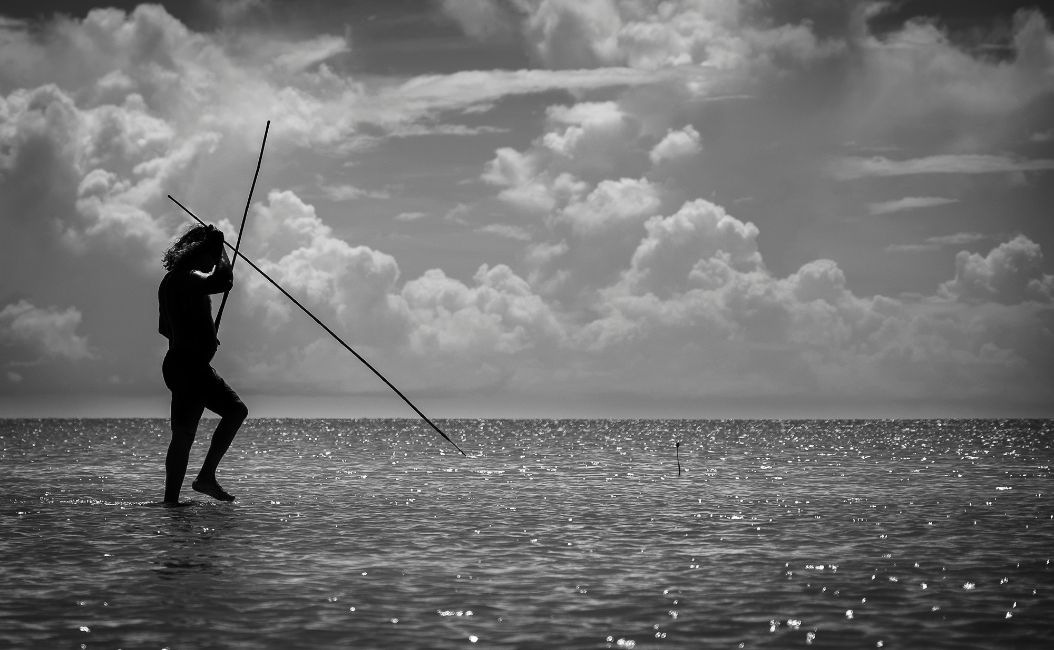
One of the standout works, The Hunter, captures this with striking clarity. A lone figure, the ocean, the act of survival. There is no spectacle, no excess, just presence. It is an image that holds its own narrative without the need for words.
The project itself evolved organically. Long in discussion between Salpietro and Brown, it came to life when both were working again on Country in Far North Queensland. Building on Brown’s established documentary relationships with First Nations communities, the work was shaped through trust, collaboration, and time.
The result is a cinematic interplay of still and moving image, where each medium informs the other.
Salpietro’s black-and-white approach lends a cinematic edge, where contrast and light are used to shape each image and deepen its sense of atmosphere.
