

Words by Maura Mancini

Recently returning home to Port Douglas from an overseas trip, I found myself once again drawn to the window seat. As the aircraft descended over Far North Queensland, the landscape came into focus with a clarity that still surprises me, no matter how many times I see it.

From above, everything connects: reef, river, rainforest, coastline - each element shaping the next. It’s a perspective that rearranges what you think you know. Familiar places become something else entirely.

There’s a particular thrill in seeing this region from altitude. The reef appears as a loose constellation of coral forms, suspended in clear water. Rivers cut through dense mangroves, tracing slow paths to the sea. Beaches stretch and dissolve into tidal flats and sandbars.

It’s not just the beauty. It’s the coherence of it all, the way the landscape reveals itself as a single, intricate system. From above, the region reads differently, in patterns and connections that are impossible to grasp from the ground.

My first helicopter sightseeing flight began almost unexpectedly, departing from the Quicksilver pontoon at Agincourt Reef; it was a gift from the company and the best one I could imagine.

One moment I was standing on the platform, the next I was strapped in, headset on, the blades gathering speed overhead. Then the lift, sudden but smooth, and the reef dropped away beneath us into deep blue.

Out there, the water held a stillness that made it feel almost transparent. Coral gardens arranged themselves into precise formations, broken by white sand cays and darker channels.

As we tracked back toward the mainland, the coastline came into view, and then the rivers, the Daintree first, then the Mossman, unfolding through dense mangrove systems before releasing into the sea. From that height, their paths felt ancient, shaped over time yet constantly moving.

On days like that, the same clarity reveals itself even from lower down. When the sea settles, it’s like looking through a glass door.

From the shoreline, or through the eye of a drone, you begin to see what usually stays hidden: rays gliding across the sand, turtles surfacing briefly, and even the slow, deliberate movement of a crocodile in the shallows.

Shadows resolve into life, each creature part of a world normally invisible from the ground. From the air, that hidden ecosystem becomes visible all at once.

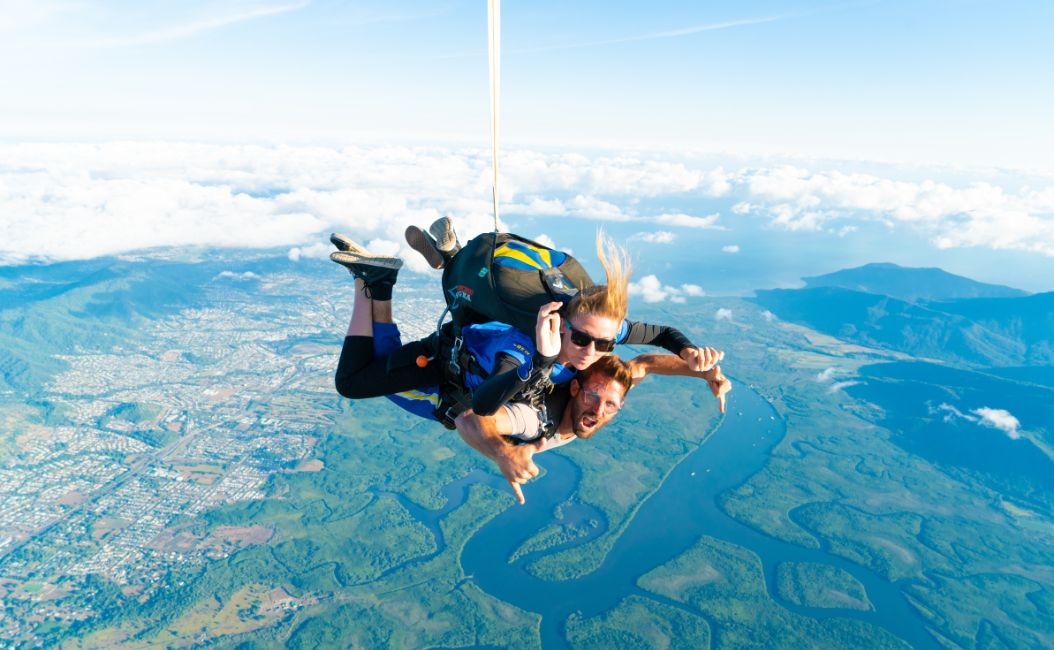
But the sky here is not only for taking in the view, it’s a stage for stories and daring. Long before I arrived in Port Douglas, I’d heard of friends jumping from helicopters and planes, gliding down to isolated sand cays scattered across the reef, while others watched from below, cheering and celebrating.

At first, it seemed unbelievable. Over time, I’ve come to know these adventurers. Their tales aren’t about danger - they’re about the exhilaration, the calm that follows when the parachute opens, and the joy of arriving somewhere completely untamed and untouched.

Recently, I watched some of my friends descend from planes during Carnival Beach Day on Four Mile Beach. I was sailing just offshore, the boat rocking as figures appeared high above the sand. One by one, their parachutes opened, unfolding like tropical flowers, carrying them slowly and gracefully toward the beach below.

On a quiet afternoon at Rex Lookout, paragliders might appear, floating along the coastline, carried by currents that cannot be seen. Watching them, the sky itself begins to feel like terrain, shaped and responsive to the land below.

Some encounters arrive without warning, appearing in the sky when you least expect them. In Mareeba, out on the Tablelands, hot air balloons often rise early, but if you don’t know to expect them, they feel like a brief interruption to the ordinary. I remember one winter, the sky glowing with pink as the sun rose, when a big balloon appeared overhead.

There was a sudden roar as the gas fired, sharp and unfamiliar, then silence again as it drifted. Suspended there, it seemed to follow no clear logic. You don’t quite understand how something so large can move so lightly. For a moment, it slows everything around it.

Sometimes at home in Port Douglas, I can hear a different sound, a faint buzzing - almost like an insect - before spotting a microlight tracing the coastline. Low and exposed, it offers a different kind of sightseeing, revealing details invisible from higher up.

From this vantage, you can follow the edges of river mouths, beaches, and catch glimpses of the rainforest as you fly over Mossman Gorge. Sandbars shift, channels open and close, and in the shallows, movement gives away the presence of marine life. This landscape is never fixed. It responds constantly, to tide, to weather, to time.

From every angle, Far North Queensland feels distinct. Rainforest meets reef without transition. Rivers carry sediment and life from one system into another. Seen from above, these connections become clear, not as separate attractions, but as parts of a larger, interdependent whole.

Far North Queensland doesn’t just look different from above. It makes sense in another way. What remains isn’t one image, but a unique understanding of the place itself.