

Words by Sara Mulcahy

Legend has it that in the 9th century, an Ethiopian goatherd noticed that after eating berries from a certain tree, his goats became so frisky they didn't want to sleep at night. He reported his findings to the abbot at his local monastery, who made a drink with the berries and was delighted to find it kept him awake through the evening prayer session. He shared his discovery with the other monks, and knowledge of the magic beans began to spread. 

Today, Australians collectively down six billion cups of coffee a year. The vast majority of it is imported from Brazil and Colombia, but we do grow our own, too. Premium Arabica coffee beans have been successfully cultivated up and down the east coast for more than a century, and 70 per cent of Australia’s coffee is grown right here on the Atherton Tablelands, about an hour’s drive southwest of Port Douglas.

A brief history of coffee

Coffee was brought to Australia on the First Fleet in 1788. By the 1880s, there were coffee plantations throughout Northern NSW and Queensland, where some 46 growers were established in the Cairns region. Coffee growing persisted into the 1920s, but the fledgling industry soon encountered problems.

Planters initially used indentured South Sea Islanders, known as Kanakas, to tend and harvest their crops, but with the introduction of the White Australia policy in 1901, that cheap labour supply was cut off.

The climate also took a toll, with frosts, droughts, and a series of cyclones damaging plantations. With the advent of World War I, transport too became a major issue as coastal trading ships were co-opted for the war effort. 

All these factors, plus the appeal of sugar cane as a preferred crop, led to the decline of the coffee industry in Queensland, and imported coffee took a grip in our shops and cafes. 

In the 1980s, however, with the decline of tobacco, a resurgence of interest in coffee cultivation began in the Mareeba/Atherton area, which now produces most of Australia’s annual harvest.

The area is perfectly suited for coffee cultivation due to its fertile volcanic soil, and a climate with sunny days, cool nights, and good rainfall.

Far North coffee

On a self-guided day trip from Port Douglas to the Atherton Tablelands, you can experience the world of local coffee-growing first-hand. Set your sat nav for Mareeba and get ready for the Far North’s best coffee experiences.

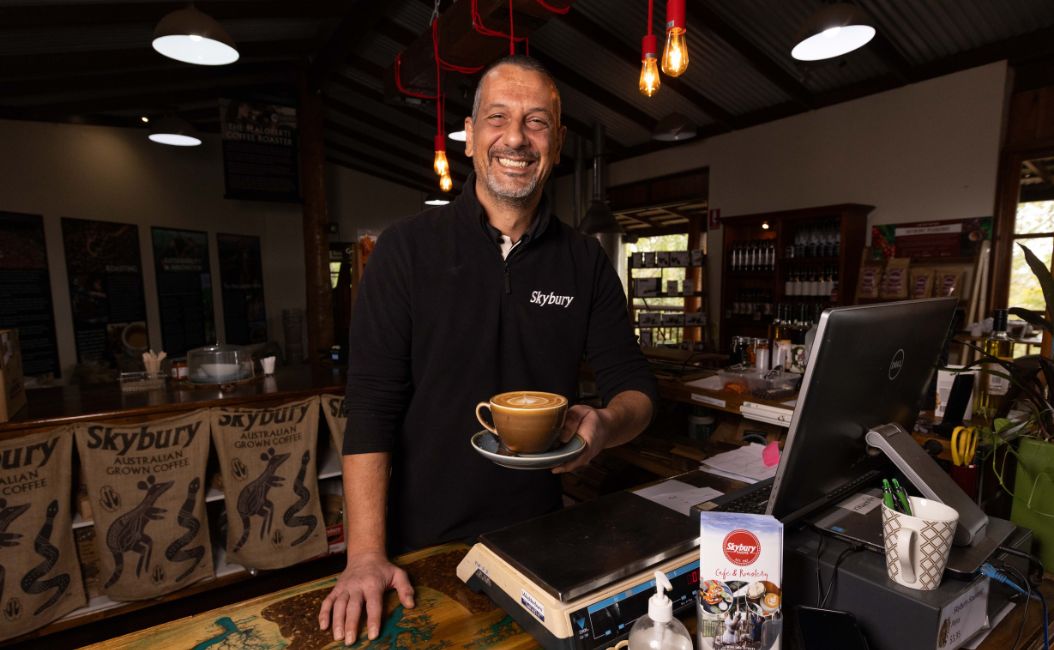
Skybury Coffee (136 Ivicevic Rd, Paddys Green) features a purpose-built tourism centre with a working roastery, licensed café and wide-open decks where visitors can relax with a cup of plantation coffee. 

Jaques Coffee (137 Leotta Rd, Mareeba) offers a two-tier tour: the simple version, where you watch a documentary, then have a look around the harvesting machinery and coffee fields; and a more in-depth adults-only guided tour of the plantation and behind-the-scenes processing, followed by a coffee tasting board and lunch. 

Jack Murat (Jackmurat.com) hosts a ‘Coffee Immersion’ three-day retreat around harvest time each winter, which takes participants behind the scenes of coffee production. From early 2026, Jack Murat will also offer short agri-tours, providing a closer look at life on an operating coffee farm.

Around the coffee clock

In the 1950s, the good-quality espresso we know and love was introduced by southern European migrants. Thanks to them, Australia is widely considered to have one of the best coffee cultures in the world. Here’s where to enjoy the good stuff in Port Douglas, any time of day.

Morning: Origin Espresso roasts and brews from 6.15 am every day at 21 Warner Street. Pair your cup with a locally made cake or doughnut.

On the run: Captain & Co Espresso serves from a hole-in-the-wall in the heart of town at 54 Macrossan Street.

Lunchtime: Enjoy a wrap or frittata accompanied by excellent coffee at Whileaway Bookshop and Café, 43 Macrossan Street.

Afternoon: Shop for freshly ground coffee, including four locally grown blends, at Coffee Works, 32 Macrossan Street

Cocktail hour: Sip on an Espresso Martini with tapas at Cosmos, 9 Grant Street.

Evening: Enjoy contemporary cuisine and an after-dinner affogato (three to choose from) at Salsa Bar & Grill, 26 Wharf Street.