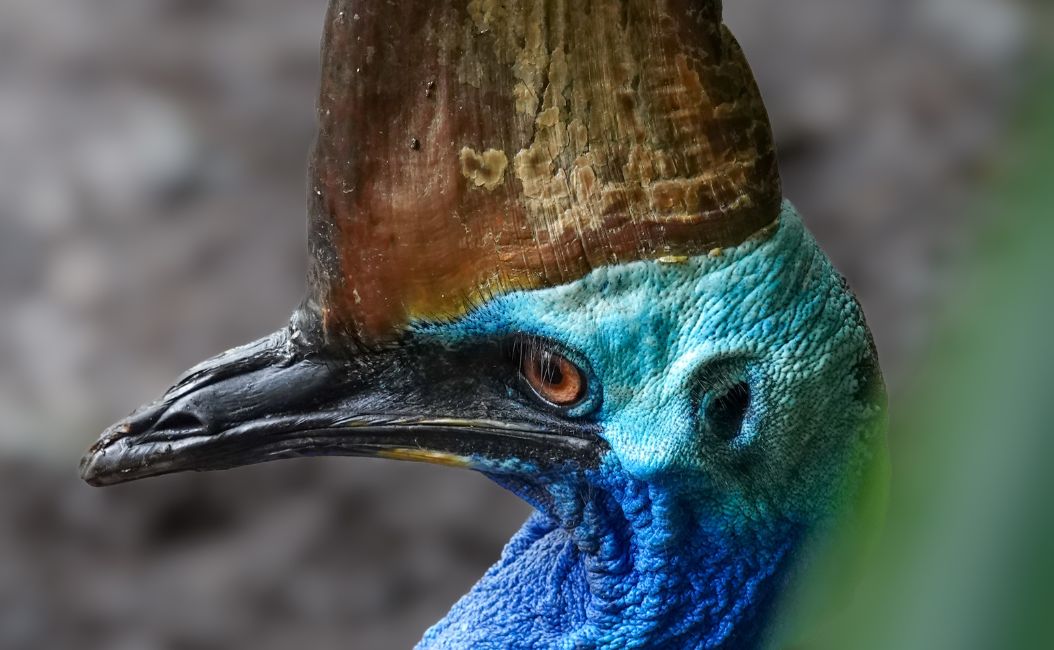


I would I were a cassowary

On the plains of Timbuktu

I'd catch and eat a missionary

Legs and arms and hymn-book too.


Words by Sarah Mulcahy


No one knows quite why there should be such tragic consequences for a missionary in Timbuktu, or even who wrote the poem. But he needn’t have worried, because one thing’s certain — there are no cassowaries in Africa. But they do roam the fringes of the rainforests in Far North Queensland.

With a starring role in indigenous creation stories, songs and dances, the Southern Cassowary is top of the ‘Must See’ wish list for many visitors to our far-flung town.

Found only in the tropical forests of PNG, parts of Indonesia and here in northeastern Australia, this brightly coloured forest-dweller is labelled the ‘world's most dangerous bird’ (see box out).

A whisker smaller than our other famous flightless bird, the emu, cassowaries play a pivotal role in the health of the Daintree Rainforest’s ecosystem, as they eat fruit and ‘disperse’ the seeds elsewhere, so new plants can grow away from the parent tree. 

One particular fruit, the smooth, blue Cassowary plum, needs to pass through the digestive system of the Cassowary to be able to germinate, and because of this, the legendary birds have earned the title of ‘rainforest gardener’.

The cassowary’s other claim to fame is that it is one of the few species where the male raises the children on his own. Female cassowaries lay a clutch of eggs (often by different fathers) on the forest floor. Dad then takes over, incubating the eggs for 50 days. Once they hatch, he stays with his stripey young charges for nine months, teaching them how to survive in the wild. (Mum, meanwhile, is long gone, looking for her next mate.)

For those hoping to catch sight of this prehistoric bird, the cassowary is as elusive as it is fascinating. The best current estimate by the CSIRO suggests the total Australian population of Southern Cassowaries is around 4,400 adults in the Wet Tropics region. Other research puts the number at half that.

Decades of land clearing have resulted in substantial habitat loss, and the cassowary

is listed as endangered under both the Australian Government's Environment Protection and Biodiversity Conservation Act and the Queensland Government's Nature Conservation Act.

Other threats come from domestic dogs and cars. At least 10 birds a year are killed by cars around Mission Beach alone — and that’s just the ones that are reported. If you see a cassowary on the road or by the side of the road, conservationists advise flashing your headlights at drivers coming the other way, to alert them to the hazard and make them slow down. 

One small piece of good news is that a 2025 trial using AI to detect cassowaries crossing the Kennedy Highway at Kuranda, and warn drivers with flashing signs, has reduced the number of bird deaths on this stretch of road by more than a third, according to the Department of Transport and Main Roads (TMR). Missionaries, take note.

Where to see cassowaries (in the wild)

The Daintree Rainforest is home to most of Far North Queensland’s Southern Cassowaries. You have a good chance of spotting them if you’re driving (slowly) or walking along boardwalks in the areas around Cape Tribulation. 

Further south around Mission Beach, there are regular sightings on the Dreaming Trail, Garner’s Beach and various beach access roads. At (dog-free) Etty Bay, between Mission Beach and Cairns, cassowaries are seen most mornings on the beach.

Where to see cassowaries (not so wild)

Cassowaries are solitary birds and don’t enjoy sharing their space. At the Wildlife Habitat in Port Douglas, Cassie and Airlie live in neighbouring compounds. Cassie was born in captivity in Adelaide and has been roaming around at the Wildlife Habitat for more than 30 years. 

At Hartley’s Crocodile Adventures, about 30km south of Port Douglas, there are cassowary feeding and information sessions twice a day on the Cassowary Walk.

Be cass-o-wary

Southern cassowaries can be unpredictable and even aggressive. One kick is powerful enough to break bones, so they’re best admired from a distance. The Queensland Government’s ‘Be Cass-o-wary’ campaign is an initiative to keep people safe around cassowaries — and protect these special birds.

• Never approach cassowaries. If you encounter a cassowary at close range, remain calm and slowly back away. 

• Never feed cassowaries. It’s illegal to feed cassowaries, as this makes them associate people and cars with food. Hefty fines apply! 

Always slow down when driving in cassowary territory and look out for the yellow ‘Recent Cassowary Crossing’ signs.