


Page 19 - Port Douglas Magazine 46
P. 19
art.                                                                                                             art.

             butterflies and other pollinators. Her passion for

             indigenous and native vegetation has deepened
             while volunteering at the local council nursery.
             Her environmental care extends naturally to the

             coastline. Coastal clearing, often for ocean-view
 Just south of Port Douglas, where the   developments, removes native vegetation that
 rainforest leans towards the sea tide, sits   anchors dunes, leaving  the shoreline exposed
             to erosion. Around her home, Rosey quietly
 Oak Beach, a quiet stretch of coastline   replants  where she can,  favouring casuarinas
 that shapes the life and creative pulse   and other stabilisers that once held the sand in
             place.
 of artist Rosey Cummings. She collects

 sun-bleached rope, discarded fishing line,   “It breaks my heart,” she says, “watching trees
             and  other  coastal  vegetation  vanish  that  used
 fragments of plastic and other washed-up   to hold this beach in place.” Her art, garden

 debris, giving them a second life while   and activism are woven from the same fibres:   an extraordinary  woman who  carried it  on a
                                               plane. In one of the studio rooms, piles of rope
 telling the urgent story of our threatened   grounded in respect for the land and shaped by   are sorted into strands waiting to become bowls,
             a desire to help restore it.
 coastline.  TECHNIQUE, TRADITION AND THE      vessels or other densely woven and stitched
             STORIES MATERIALS TELL            forms reminiscent of coral, sea creatures, and
                                               the tangled patterns of nature, including delicate

             Rosey’s weaving journey began years ago, when   jellyfish-like shapes made from natural looking
 Her home studio, tucked behind a flourishing garden of   Margie and Yvette, two women living at Cooya,   plastic mooring rope.

 natives, ferns and winding vines, feels like an extension of   invited her  to sit with  them  weekly,  weaving   Her technique is slow, intentional and physically

 the landscape itself, a place alive with birds, butterflies and   with natural fibres and sharing knowledge.   demanding. For works made from Alexander

 other creatures drawn to the plants she grows. Standing   She honours those teachings, and those of   palm inflorescences, she soaks the pieces several

 there, Rosey says something that stays with me: “This   First Nations weavers whose workshops she   times before weaving. For others, she must strip

 landscape guides everything I make.”  has attended, while emphasising that her work   and tease rope apart and stitch using the rope
             comes from respect and inspiration rather than   strands themselves, a process requiring many   Coastal Requiem; Vine wreaths,
 Her practice is anchored, quite literally, in the land and sea   cultural appropriation.  spider lily string, seeds.

 around her. She works with weaving and environmental   hours a day over several days and often harsh on
 sculpture, but the materials she uses are far from   She  recalls  something  a  First  Nations  weaver   the hands.


 traditional. Most are natural, found or recycled, gathered   once told her during a weaving session, that she   “It’s rare to find rope strong enough to stitch   Vessel, crafted from found wire, old fishing line,

 during near-daily walks with a bucket along Oak Beach or   felt the maternal presence of her grandmother in   with,” she explains. “It’s a love-hate relationship.   a wooden reel and discarded crab pots, speaks to

 collected during beach clean-ups with her sister and the   her hands as she wove, a moment that continues   The colours are beautiful, but I wish they weren’t   the consequences of fishing-industry debris. No

 Tangaroa Blue Foundation across Far North Queensland.   to resonate.  here at all.”  Boundaries, a collaboration using rope collected
 Other pieces come from like-minded environmental                                   in the Outer Hebrides by a local marine biologist
 caretakers who, like Rosey, refuse to let coastal debris   Inside her studio, she shows me an enormous   FUNCTIONAL, CONCEPTUAL, AND   friend, underscores that ocean pollution knows

 vanish unnoticed.  handcrafted wooden weaving frame, made for   ALWAYS SITE-SPECIFIC  no borders; debris travels on currents from the
             her in her early twenties by a dear friend and                         USA, South East Asia, the Pacific and beyond.

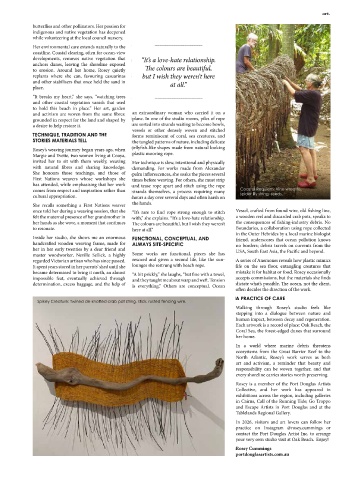
 Weathered ropes, tangled fishing line, broken plastic   master woodworker, Neville Sellick, a highly   Some works are functional, pieces she has


 pieces, oxidised wire and palm inflorescences are   regarded Victorian artisan who has since passed.   rescued and given a second life, like the sun-  A series of Anemones reveals how plastic mimics

 reimagined as vessels, sculptural forms or coiled “sand   It spent years stored in her parents’ shed until she   lounges she restrung with beach rope.  life on the sea floor, entangling creatures that
 bowls”, each echoing the story of the shoreline where they   became determined to bring it north, an almost   “A bit prickly,” she laughs, “but fine with a towel,   mistake it for habitat or food. Rosey occasionally


 were found.  impossible feat, eventually achieved through   and they taught me about warp and weft. Tension   accepts commissions, but the materials she finds


             determination, excess baggage, and the help of                         dictate what’s possible. The ocean, not the client,
 ART AS ENVIRONMENTAL WITNESS                  is everything.” Others are conceptual. Ocean   often decides the direction of the work.

 Before settling permanently in Far North Queensland,                               A PRACTICE OF CARE
 Rosey worked in Melbourne’s public health system as a   Spikey Creature; Twined de-knotted crab pot string, stick, rusted fencing wire.

 nurse in sexual health. After moving north, she continued                          Walking through Rosey’s studio feels like
 in the same field, often travelling to remote communities                          stepping into a dialogue between nature and


 to support local health facilities. Though she doesn’t                             human impact, between decay and regeneration.
 explicitly connect this work to her art, moving through                            Each artwork is a record of place: Oak Beach, the
 Sun Vessel; Beach Rope, rusted fencing wire, Coiled and Stitched.
 different landscapes and communities shaped her sense                              Coral Sea, the forest-edged dunes that surround

 of place and sharpened her awareness of how deeply                                 her home.
 people rely on and connect with healthy environments.                              In a world where marine debris threatens
 WEAVING THE   Life in the tropics offered a different rhythm, and a deeper         ecosystems from the Great Barrier Reef to the


 appreciation for the fragility of coastal ecosystems.
                                                                                    North Atlantic, Rosey’s work serves as both

 The debris she gathers now lives on in her sculptural                              art  and  activism,  a  reminder  that  beauty  and
                                                                                    responsibility can be woven together, and that
 works, not as trash transformed into beauty, but as
 TIDES: The Art and   witnesses to the pressures on our marine world.               every shoreline carries stories worth preserving.
 “As I work,” Rosey says, “I reflect on the structures, forms

                                                                                    Collective, and her work has appeared in
 and colours of the materials and where they’re collected.                          Rosey is a member of the Port Douglas Artists
 Purpose of Rosey   What are they telling me? How much do I deconstruct             exhibitions across the region, including galleries
                                                                                    in Cairns, Call of the Running Tide; Go Troppo

 them? How do I see them differently?” Her practice is
                                                                                    and Escape Artists in Port Douglas and at the
 both a conversation and a confrontation: delight in the
 Cummings  colours and textures shaped by the sea, and sadness that                 Tablelands Regional Gallery.
 they exist at all.
                                                                                    In 2026, visitors and art lovers can follow her
 A GARDEN THAT TEACHES, A COASTLINE THAT
                                                                                    practice on Instagram @rosey.cummings or
 NEEDS HEALING                                                                      contact  the  Port  Douglas  Artist  Inc.  to  arrange
                                                                                    your very own studio visit at Oak Beach.  Enjoy!
 Rosey’s home garden is as much a part of her creative
 life as her studio, a wild, vibrant space filled with native                       Rosey Cummings

 Words By Maura Mancini  plants, many chosen specifically to attract the local birds,   portdouglasartists.com.au

